These days, nobody might feel surprised when you browse for something on Google and a full-fledged AI summary of the same appears, owing to AEO optimization. It pulls content from multiple sources, synthesizes an answer, and presents it to the user before they've clicked on anything is increasingly the first thing someone sees.
If your content is being cited in that summary of Answer Engine Optimization, you're benefiting from a new form of visibility that wasn't available a few years ago. If your competitors' content is being cited while yours isn't, you're losing presence to a search behavior shift that is accelerating, not plateauing.
Answer Engine Optimization, Generative Engine Optimization, and traditional SEO are not competing strategies; neither are they foreign terms for digital marketing professionals. They are three layers of the same objective: making your content discoverable, extractable, and trustworthy enough that AI systems choose to use it when generating answers relevant to what your business does.
Understanding the Three Layers Before Checking Any Boxes
SEO in the context of AI search is about discovery: whether AI systems can find, crawl, index, and understand your website well enough to consider it as a potential source. This hasn't gone away. AI systems still rely on search indexes, crawlable site architecture, and authority signals. What changed is what happens after discovery.
AEO is about extractability: does your content make it easy for an LLM to scan through and find specific answers or responses to cite in its AI-generated response? A page that ranks well but buries its answers in paragraphs of marketing language is less useful to an AI answer engine than a page that answers questions directly, early, and in structured formats the AI can parse reliably.
GEO: Generative Engine Optimization is about trust and reuse. Whether AI systems evaluate your brand and content as credible enough to cite. Authority now affects whether content gets included in AI-generated responses at all, not just where it ranks. An AI system is effectively asking: "Is this a reliable enough source to use in my answer?"
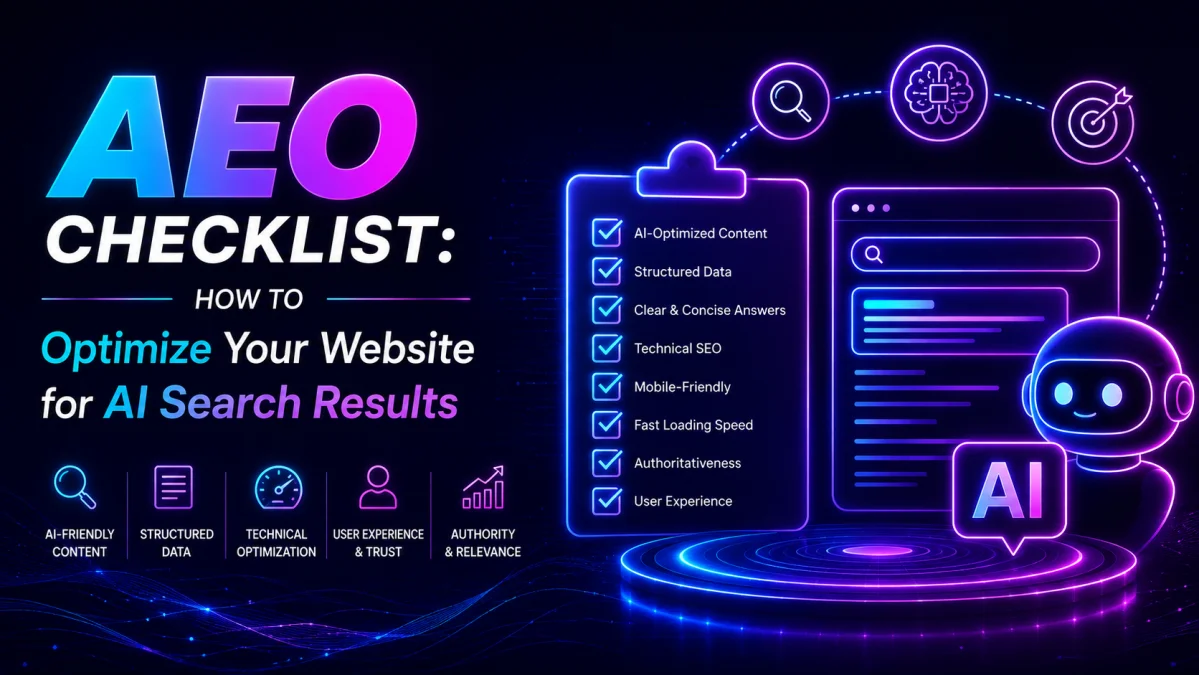
The checklist below works through all three layers in sequence.
Layer One: Foundational SEO: Can AI Find Your Content?
Site crawlability and indexation:
Verify your robots.txt isn't accidentally blocking pages you want AI crawlers to access. Confirm your sitemap is current and submitted. Check that important pages are not set to noindex. AI systems need to be able to access and index your content before any other optimization matters.
Technical performance:
Core Web Vitals loading performance, interactivity, and visual stability affect both traditional ranking and AI source consideration. Slow-loading pages that crawlers cannot process efficiently get deprioritized. Mobile usability is non-negotiable; most searches happen on mobile devices and AI systems evaluate mobile experience.
HTTPS and site security:
This is foundational enough that it barely warrants mentioning except that businesses still occasionally encounter issues here. Secure sites receive preference signals across every search system.
Clear URL structure and page titles. Descriptive URLs and titles that accurately represent page content help AI systems understand what a page covers before processing its full content.
Layer Two: Content Structure: Can AEO Services Help Extract Clear Answers?
This is where most websites have the most room for improvement, and where the structural changes produce the most visible impact on AI search visibility.
Answer questions early and directly:
AI systems favor content that provides clear answers without requiring the reader to work through extended preamble. If a page is answering a specific question, the answer should appear in the first two to three sentences. Generic marketing introductions "We are a leading provider of..." delay the answer and reduce extractability.
Use a clear heading hierarchy:
A logical chronology of headings (H1, H2, and H3...) makes it possible for AI systems to navigate your content and extract specific sections relevant to specific queries. Heading hierarchy is not just visual organization; it's semantic structure that AI parsing relies on.
Build FAQ sections around the questions your audience actually asks. FAQ sections are among the most frequently extracted content types in AI-generated responses.
Use lists and tables where appropriate:
Structured formats, numbered lists, bullet points, comparison tables are significantly more extractable than prose-only content covering the same information. This isn't about gaming AI systems; it's about showcasing information in the format that humans as well as LLMS both find clearest.
Write concise answer blocks:
Distinct content sections with a clear purpose, a direct answer, and supporting context perform better as extract targets than extended paragraphs where the answer is distributed across multiple sentences.
Layer Three: Machine Readability: Can AI Interpret Your Content Correctly?
Structured data implementation. Schema markup communicates content relationships explicitly to AI systems rather than requiring them to infer structure from page layout. Article schema, FAQ schema, How-To schema, and Organization schema all provide explicit signals about what content represents and how it relates to other content on the site.
Accurate meta titles and descriptions. These communicate page intent to both traditional search systems and AI crawlers before page content is processed. Meta descriptions that accurately describe page content rather than serving as marketing copy perform better as source signals.
Descriptive alt text on images. Alt text contributes to AI systems' understanding of page content, particularly for content where images carry information that the surrounding text doesn't fully describe.
Consider an /llms.txt file. An emerging practice in technical GEO, an /llms.txt file provides AI systems with explicit guidance about your site's content, structure, and intended use as a source, similar in concept to robots.txt but oriented toward large language models rather than traditional crawlers. Adoption is growing among organizations actively managing their AI search presence. For a proactive and leading journey towards being cited by an AI platform, join hands with AEO GEO AI search engine optimisation services.
Layer Four: Authority and Entity Signals: Will AI Trust Your Content Enough to Cite It?
Establish clear organizational identity. AI systems evaluate whether they can clearly identify who is behind a piece of content. Visible organization name, location, founding information, and area of expertise on an About page that actually contains useful information rather than marketing platitudes contribute to entity recognition that affects citation likelihood.
Visible authorship and expertise signals. Content with identified authors, visible credentials where relevant, and bylines that connect to author pages with genuine biographical information signal that the content has a human expert behind it, not just a content production process.
Build topical authority through content depth. A single strong article on a topic matters less than a comprehensive body of content demonstrating sustained expertise across a topic area. Topic clusters, pillar content supported by related content on connected subtopics signal topical authority that AI systems evaluate at the site level, not just the page level.
External citations and references. Linking to credible external sources within content signals intellectual honesty and provides AI systems with context about how the content relates to the broader information landscape on a topic. Content that exists in complete isolation from external sources is harder to evaluate for credibility than content that demonstrates awareness of the existing knowledge base.
Keep content current. AI systems favor content that reflects current information over content that may be outdated. Regular updates to existing high-performing content updating statistics, adding current examples, revising recommendations that have changed maintain currency signals that affect how frequently and confidently AI systems cite a page.
The Common Mistakes That Kill AI Search Visibility
Generic marketing copy that communicates brand positioning without answering any specific question provides nothing for AI systems to extract. Walls of text without strategic answer engine optimization are difficult for AI to parse into extractable sections. FAQ sections where the "answers" are actually invitations to contact the company rather than genuine answers to the question.
Pages that score well on Layer One but poorly on Layer Two are technically accessible but not extractable. Pages that score well on Layers One and Two but poorly on Layer Four are structured correctly but haven't built the authority signals that determine whether AI systems trust them enough to cite.
The fixes required at each layer are different in nature. Layer One fixes are technical and implementation-oriented. Layer Two fixes are content and structure decisions. Layer Three fixes are markup and schema work. Layer Four fixes are the result of sustained content investment and brand presence building over time.
FAQs
Why is AEO essential in today’s era?
Marketing depends quite a lot on digital forms these days. Plus, search engines like Google also display AI results as initial results. This makes it crucial for any brand to have a presence in the AI sphere.
What makes you visible in AI?
Clear and authentic information, extractable content, a genuine and well-built website, and FAQs make the content more fetchable by AI.
Why is authority more important in AI search?
AI doesn’t just rank pages; it chooses sources to cite, so it favors content that is credible. This is what makes authority important.
What makes AI more inclined towards a certain piece of content?
Content with a nature that aligns with conversational responses of AI is suitable for AI citations.
How to connect with Fusion Logic to seek AEO Solutions?
Call Fusion Logic at +(1) 760-340-6500 to get in touch.