PPC can fill your pipeline faster than almost any other channel but only when it's built correctly. Here's what CMOs and business owners actually need to know before spending a dollar on paid search.
Let's be honest about something most marketing agencies won't say upfront: PPC advertising for small businesses is one of the fastest ways to generate leads. It is essential for any kind of digital marketing goals, yet it is one of the fastest ways to burn through a budget with very little to show for it.
The difference between those two outcomes is not limited to the platform; strategy is the one that can turn the tables. Increasing budgets beyond need won't help if the strategy cannot sense the audience’s pulse.
For CMOs and business owners evaluating outsourced digital marketing services, understanding what Google Ads instant leads actually are, and more importantly, what makes them work, is a conversation worth having before it's time to talk about monthly ad spend.
What PPC Advertising for Small Businesses Is, Exactly?
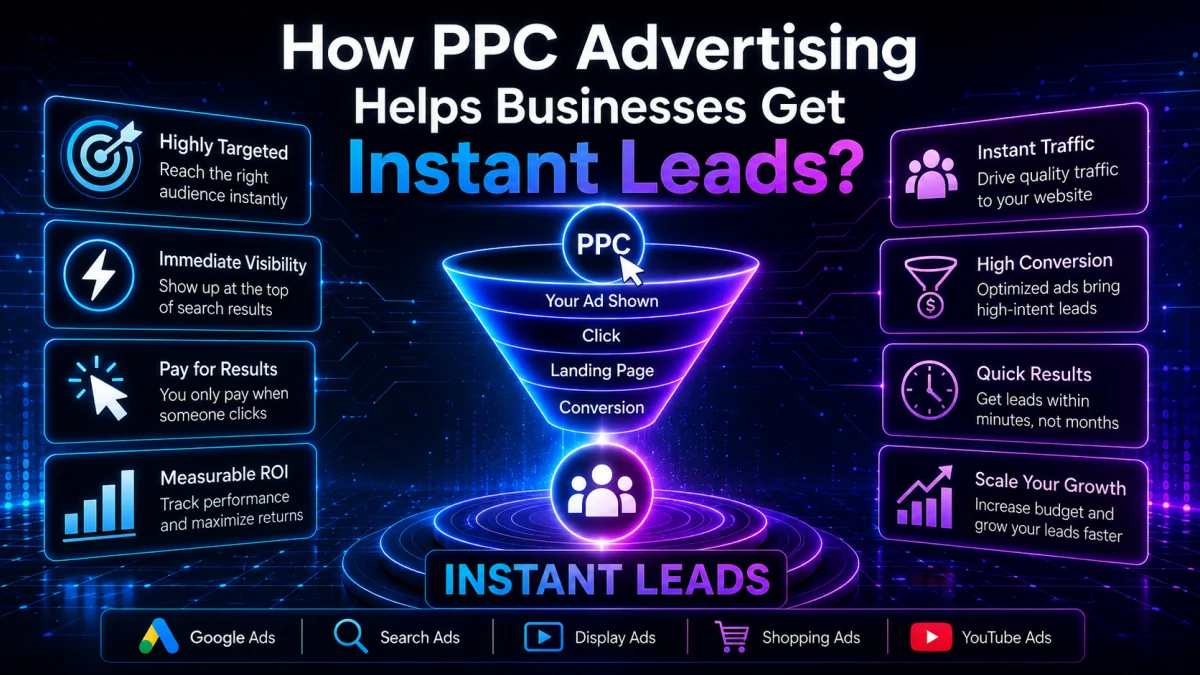
The defining principle is: you pay when someone clicks your ad, not when they see it. An ad can appear ten thousand times without costing a penny; the cost is triggered by the click itself.
Paid search specifically refers to ads that appear on or above search engine results pages, placed through an auction system that runs every time a relevant search query is entered. Advertisers bid on the keywords they want to appear for, and the search engine determines which ads show up and in what position.
Search engines factor in ad relevance, expected click-through rate, and landing page quality alongside the bid. A well-crafted, creatively made, genuinely relevant ad can outrank a higher-spending competitor for PPC advertising for small businesses.
PPC also extends beyond search. Display advertising places ads across websites in a broader advertising network. Remarketing targets people who have already visited a site.
Such ads show up when a user is looking for a relevant, specific solution, not casually browsing. This is what makes PPC marketing still perform. Placing a relevant, credible ad in front of that person at that exact moment is dramatically more efficient.
The AI Angle for pay-per-click lead generation
Now that AI ads are also in the digital marketing sphere, to give tight competition, ChatGPT ads would act like a new paid-media channel inside a conversational decision-making environment. For PPC management services, this is a new plane to conquer. However, the focus on keywords will shift to user intent, context, and the problem being discussed. In fact, ChatGPT can help shape the demand while the user is in a conversation with the AI platform. Here, the ad has to sound useful, not promotional.
What Most Campaigns Get Wrong about PPC Marketing?
The speed advantage creates a seductive but dangerous oversimplification: that launching a campaign and funding it adequately is sufficient to generate profitable leads. It is not, and this is where the nuance that most agencies skip over actually lives.
Keyword selection is where lead quality is determined before a single click happens. Ads are triggered by keywords, and the relationship between keyword selection and the quality of traffic it attracts is direct and unforgiving. Broad keyword choices that seem logically relevant often reach people at completely different stages of intent, or no purchase intent at all.
A professional services firm bidding on broad terms attracts a very different audience than one bidding on specific, high-intent phrases that describe the exact problem their ideal client is trying to solve right now. The specificity of keyword selection determines whether the traffic that arrives has any realistic chance of converting into a pay-per-click lead generation worth having.
Negative keywords, the terms that explicitly prevent ads from showing for irrelevant searches, are equally important and consistently underinvested by businesses managing campaigns without deep expertise. A campaign without a well-developed negative keyword list spends real budget reaching people who were never going to become customers, while reducing what's available for the people who actually would.
Ad copy has to earn the click, not just get it. Because quality factors into the auction, ad copy that generates strong click-through rates improves quality scores, reducing cost per click while improving positioning simultaneously. But the more important implication is that ad copy accurately representing an offer produces better-qualified traffic.
The landing page is where campaigns succeed or fail, and it receives the least attention. This is the part of PPC that produces the most significant variance in results and gets the least scrutiny in most campaign audits.
How to Think About Costs Without Getting Misled by the Wrong Metrics?
Cost per click is a starting point, not a conclusion. A campaign with a higher cost per click that converts well is almost always more profitable than one with a low cost per click and weak conversion rates, which is the lesson that businesses learn after comparing platforms or campaigns using CPC as the primary benchmark.
The metrics that actually connect to business outcomes are cost per lead, lead-to-sale conversion rate, and customer acquisition cost relative to lifetime value. A business with high customer lifetime value, a law firm, a managed services provider, or a financial advisory practice can justify a higher cost per acquisition than a business operating on thin margins and single transactions. The appropriate benchmark for PPC economics is always specific to the business model, not generic to the channel. Campaign type choices affect cost efficiency significantly as well.
When PPC Produces the Best Returns
Paid search works best when real search volume exists for what a business offers, when people are genuinely typing relevant queries into search engines in meaningful numbers. For businesses in categories with clear, active search behavior, such as legal services, healthcare, home services, financial services, IT support, and professional services, there is existing demand to capture, and PPC connects to it quickly and efficiently.
Note that keywords shift. Competition evolves. Audience behavior changes. Campaigns that improved month-over-month outperform campaigns that were set up well and then left alone.
What This Means for CMOs Evaluating Paid Search?
Here, the right questions are not just about cost and coverage. They are about the strategic depth behind the campaign, the keyword research methodology, the negative keyword discipline, the landing page testing process, and how the agency defines and improves lead quality over time.
A well-managed PPC program is one of the most measurable, accountable marketing investments available. Every dollar is traceable. Every click is logged. Every conversion is attributed. That transparency is an asset for performance marketing leadership when the measurement infrastructure is set up correctly, and the right things are being measured.
When it isn't, that same transparency can produce a lot of impressive-looking reports that don't connect to pipeline reality.
How Fusion Logic can help you?
PPC advertising can generate leads faster than almost any other channel, and Fusion Logic builds SEO strategies for businesses that want gradual and noticeable growth. Our digital marketing strategy includes PPC advertising with all the weight it carries.
Book a free PPC audit today and find out what your current campaigns are missing.