The first wave of marketing AI was mostly generative. Write a blog post. Generate an image. Draft an email. Useful, sure. But let's be real, that's not transformation. That's a productivity hack.
The shift happening right now is bigger. Now, workflows are planned and scheduled with the help of AI. You can chain multiple operations through one platform and won’t have to worry about running out of time.
AI has already set a strong foot when it comes to marketing, especially the digital kind. More and more marketers, strategists, and SEO executives are turning to AI. Now, there is not only ChatGPT, but also Gemini or Perplexity, Jasper, Claude, and Zapier, too, are enhancing the entire marketing funnel.
In this scenario, professionals who blindly start using AI for content generation, email marketing, scheduling and calendars won’t really stay long in the game. AI is all strategy and clear, and a hierarchical goal-driven mechanism.
AI in Digital Marketing: Personalization Has Crossed the Glass Ceiling
For years, personalization in marketing meant segmenting an email list by demographic category and changing the first-name field.
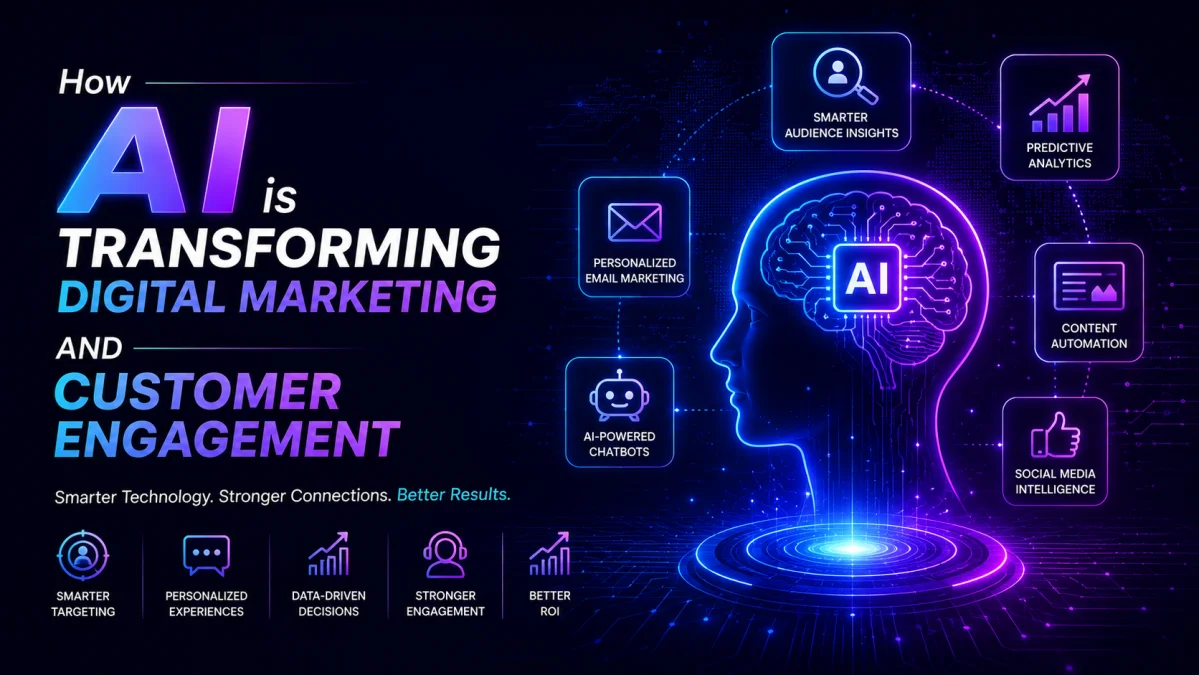
Modern AI in digital marketing analyzes real-time behavioral data, such as what a user clicked, their intention, and how long they spent on a specific page, helping to craft an accurate AI customer engagement strategy.
Personalization engines powered by AI are delivering 2.7x ROI right now. Not theoretical. Live. The difference is that these systems aren't just sorting customers into demographic buckets and swapping out a first name tag. They're reading real-time behavior, what someone browsed, how long they lingered, what they abandoned, and reshaping the experience on the fly.
AI-managed ad campaigns, including artificial intelligence marketing tools, are seeing 22% higher ROI and 32% more conversions than manual campaigns. That's not a gradual improvement. That's a gap wide enough that ignoring it is effectively leaving money on the table.
Remember when segmenting by age and location felt advanced? Feels quaint now, doesn't it?
Predictive Analytics: How They Changed the Timing of Marketing Decisions
Reactive marketing responding to what happened last month, adjusting based on last quarter's data, has always carried an inherent lag. By the time patterns are visible in historical data, the optimal response window has often already passed.
Predictive AI allows marketers to identify high-churn risks before the churn happens, surface high-value leads before competitors reach them, and determine optimal engagement timing based on individual behavioral patterns rather than generalized best-practice windows. AI marketing automation-led ad campaigns deliver more conversions than manually managed equivalents, according to recent benchmarks, a performance gap that reflects the difference between human capacity to process signals and AI capacity to process signals at scale.
The practical implication for marketing teams is that decision latency, the time between a relevant signal appearing and an appropriate response being deployed, compresses significantly when predictive analytics are integrated into campaign management. A lead demonstrating high-intent behaviors gets a different touchpoint than a lead in early awareness mode, automatically and immediately, rather than after someone reviews a report and schedules a campaign adjustment.
Conversational AI Has Graduated From Chatbot to Sales Infrastructure
The early chatbot era was marked by frustrating scripted trees that answered narrow questions while failing to help with anything adjacent. Ask anyone who tried to get a useful answer from a website chatbot before 2022, and you will receive a detailed and unhappy account.
Current conversational AI is a different category of capability. Sophisticated AI agents now guide users through complex sales funnels, provide personalized product or service recommendations based on demonstrated preferences, handle objections with contextually appropriate responses, and escalate to human agents at exactly the right moment rather than either keeping users trapped in automation or unnecessarily routing simple queries to expensive human support.
Businesses implementing advanced conversational AI are seeing reductions in human support volume of up to 40%, which sounds like a cost-reduction story but is also a customer-experience story. Customers who get immediate, relevant, accurate answers at any hour have a fundamentally different brand experience than those waiting in a queue or navigating a FAQ page. Conversational AI, when done well, makes engagement more available and more responsive than human-only support models can sustain cost-effectively.
The Shift From Content Generation to Agentic Workflows
Content creation remains the most visible AI use case in marketing 77% of marketers report using AI in digital marketing for content generation, and the productivity gains are tangible. Marketers save an average of 6.1 hours per week using AI tools, contributing to a 42% increase in overall content output across teams that have integrated AI into their production workflows.
The strategic implication for marketing leaders is about resource reallocation as much as efficiency. The 6.1 hours saved weekly per marketer is not a cost reduction opportunity; it is a reallocation opportunity. High-judgment strategic work, creative direction, brand positioning, and the human relationships that no AI manages well are where that recovered time should go. Teams using AI to produce more generic content are getting productivity gains while generating diminishing marginal returns. Teams using AI to handle the mechanical layers while concentrating human talent on strategy and creativity are building a genuine competitive advantage.
The Catch: Skills Gap regarding AI in Digital Marketing
Here is where the honest conversation diverges from most AI-in-marketing presentations.
Not surprisingly, out of 100% of businesses, 87% utilize AI. However, only 13% of them extract the true strength of AI, Like Fusion Logic, setting up workflows and trusting it without consistent human involvement.
The gap between having AI tools and deriving meaningful business value from them is large, real, and not closing as fast as the adoption rate suggests. This gap exists for several connected reasons.
Data quality problems undermine AI outputs before they start. AI systems are only as reliable as the data they process.
Skills gaps within marketing teams mean AI tools often get used at a fraction of their capability. Setting up a tool is not the same as building a workflow around it. Running a chatbot is not the same as optimizing a conversational marketing program.
Working hand in hand with AI for digital marketing requires consistent adaptation, too. It's not a one-time solution, nor is one size fits all. Predictive analytics that doesn't connect to campaign management can identify opportunities, but cannot act on them at the speed at which the opportunity value lives.
Basically, with AI, you keep the strategy. You keep the brand voice. You keep the relationship with your customers. But you let someone else handle the algorithmic heavy lifting.
Stop experimenting. Start executing.