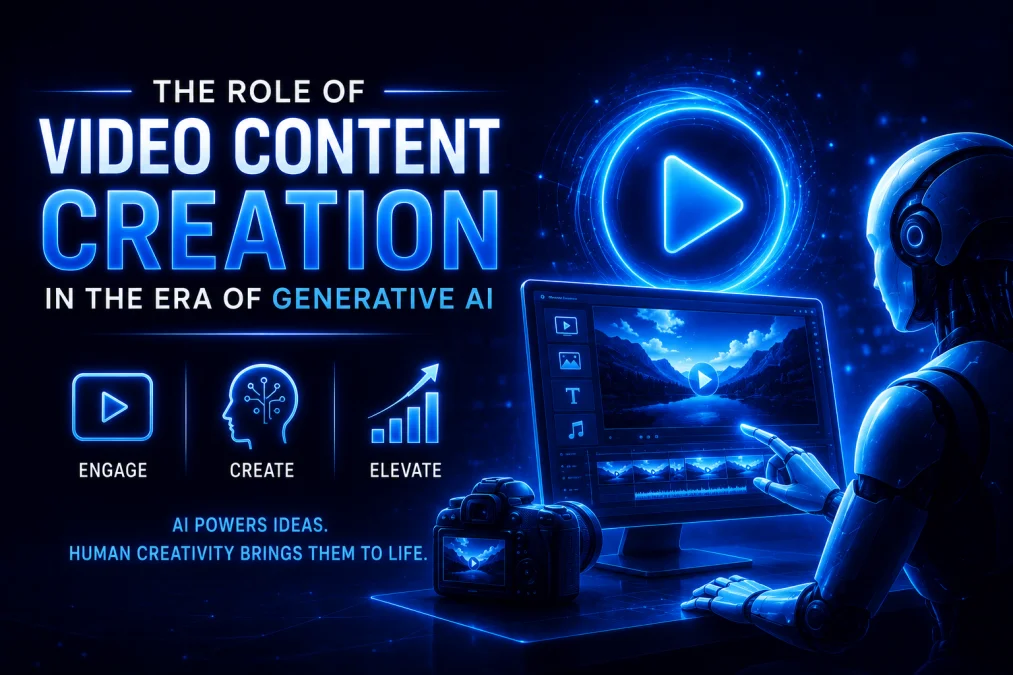
Video has always been the most persuasive format available to marketers. Watch time, recall, and purchase intent, video beats every other content type across all three. But for most marketing teams, the economics never quite worked. Studio time, production crews, post-production rounds, voiceover talent, and even a modest video campaign required budgets and timelines that smaller teams rarely had. That problem is now solved, and it has been solved faster than most people in this industry expected.
With generative AI, professional-quality video production has become a lot simpler, a goal the business spent years trying for via templates and outsourcing. Most marketers were using AI video generators to handle their projects by mid-2025. It greatly lowered expenses.
Marketers across the world have increased digital video ad content exposure in 2025. They expect videos to generate a high ROI; in fact, the best ever reported.
These figures don't indicate that the trend is still in the formative stages. They describe a market that has already moved.
For any digital marketing company still treating video as a future priority, that future has arrived.
The Economics of Video Production Have Fundamentally Shifted
The old production model had a fixed cost structure that resisted efficiency. A campaign required a brief, a production company, shoot dates, talent, editing rounds, and a publish window of four to six weeks. One video. One version. One audience cut. If the creative missed, there was rarely any budget left to fix it.
AI tools have dismantled that structure at every stage. Text-to-video platforms convert a written brief into usable footage within hours. AI voiceover generation has made recording sessions optional for most content types. It now features in 58 percent of marketing videos.
An automatic editing program examines unprocessed footage, identifies high-performing segments, and formats the output for every platform without human input. More than one-third of marketing departments use automation for routine tasks such as captioning, resizing, and cross-channel reformatting.
The output numbers are striking. AI-generated product demonstration videos are delivering 40 percent higher conversion rates than generic alternatives. Brands producing 20 or more videos monthly see 30 percent higher engagement than those producing fewer than 10. What once required a dedicated production department can now be executed by a lean team with the right tools and a clear content strategy. The constraint has moved from budget and production capacity to creative judgment and strategic direction — which, for a skilled digital marketing company in USA, is exactly where it should sit.
Video Has Become a First-Class SEO Asset
Search behavior has shifted in ways that have direct implications for how search engine optimization services are structured. Google's AI Overviews now pull from YouTube and other video platforms when constructing answers to user queries.
Product comparison searches, how-to queries, service explanations, video content surfaces as a primary result on these query types with growing regularity. A web page competing against a well-optimized video for the same query is increasingly at a disadvantage.
This means video can no longer be treated as supplementary to an SEO strategy. It belongs in the core of it. Professional SEO services that do not account for video are leaving a significant portion of the ranking surface unoptimized, which, in competitive categories, is a problem that compounds over time.
Treating video as a proper SEO asset requires the same discipline applied to any indexed page:
- VideoObject schema markup on every published video, giving search engines accurate information about content topic, duration, and context
- Published transcripts, not just for accessibility but also because they generate a lot of searchable text that boosts search results alongside every video.
- Titles and descriptions created around real search keywords, not internal labels or imaginative titles that viewers never type.
- Video embedded within relevant written content to extend time-on-page and lower bounce rates, both of which remain meaningful ranking signals.
The best SEO company in USA has these practices standardized across client workflows. Video optimization is not a specialty service anymore.
Social Platforms Are Discovery Engines, and Video Is Their Currency
The underlying dynamics across every major social platform have changed. Instagram Reels, TikTok, and YouTube Shorts have a steady supply of short-form video content. These videos have a large natural reach and are popular among today's youth.
Seventy-two percent of TikTok users have purchased only goods they first saw in a short-form video. This calls for a real re-evaluation of what social media optimization really entails on these sites.
Reaching existing followers is a secondary objective. The primary objective is discoverability by people who have never heard of the brand, and that requires understanding how each platform's algorithm reads and distributes new content. Audio selection, caption keyword strategy, posting cadence, vertical format compliance, and engagement velocity in the first 60 minutes after publication all influence how far a piece of content travels.
There is a search dimension that many marketing teams still underweight. Sprout Social's 2025 study finds that 41% of Gen Z consumers go directly to Instagram or TikTok to find goods and services rather than using a typical search engine.
A social media optimization company that is not optimizing content for in-platform search is missing how a substantial share of the buying audience actually starts its journey.
The best SMO services in USA treat social platforms as search environments, not just publishing channels, and build content strategy accordingly.
Four Advantages That Hold Up Under Scrutiny
Much of the coverage around AI video focuses on novelty. What actually matters to marketing teams is what changes in practice. Four things reliably do for brands that integrate AI video with genuine discipline:
- Production volume scales without headcount scaling: A team that produced four videos monthly can produce forty. The constraint shifts from how much can be made to what should be made — a fundamentally better position to be in.
- Personalization becomes a workflow decision, not a budget conversation: Creating separate video variants for different audience segments once required separate production runs. AI generation makes audience-specific messaging a standard campaign option, adjusting visuals and calls to action by segment without rebuilding each asset from scratch.
- Creative testing becomes data-driven before campaigns commit: Rather than betting production budget on a single concept, teams generate multiple versions and test them against actual audience behavior. Decisions get made on evidence, not assumptions.
- Brand consistency holds at volume: With manual creation, keeping a consistent visual identity and tone throughout YouTube, Instagram, LinkedIn, and the corporate website is challenging at scale. Template-based artificial intelligence creation guarantees uniformity in a way seldom supported by human processes.
None of this is automatic. The MIT Sloan research worth noting here is that 95 percent of generative AI pilots fail to produce measurable business value, almost always because tools were deployed without strategic scaffolding.
Access to AI video tools is not the differentiator. Deploying them within a strategy tied to clear objectives and accountable outcomes is. That is what the best digital marketing services providers build first.
What the Enthusiasm Tends to Skip Over
Speed and volume are the big movers. However, they also bring risks. Before they confront a problem, brands scaling AI video production must address such issues.
The United States copyright laws governing AI-generated content remain uncertain. Models built on current materials raise intellectual property concerns that neither the platform's terms of service nor current laws fully address.
Before such concerns surface in a disagreement, brands creating AI-generated video at scale must have written policies on source inputs and content ownership, ideally reviewed by legal counsel, prior to production.
Audience trust is more fragile than adoption rates suggest.
Where credibility is important, for example, in educational material, brand storytelling, and trust-sensitive areas, viewers show a definite inclination toward human-created content in a 2025 comparative research.
In 2024, the audience reacted strongly to an AI-generated Coca-Cola commercial. The reaction was more for a lack of emotional connect and less for technology use.
Good creative ideas occasionally come from faster production and lower costs.
The quality control aspect should also be considered. While the video output generated every time is always the result of artificial intelligence, it should be supervised.
The process has to incorporate quality control. Human review of AI-generated video material is essential. To be consistent with brand, voice, cultural awareness, and correctness, this is absolutely required. The efficiency gains from AI production are genuine. So is the reputational cost of publishing content that should have been caught before it went out.
Conclusion
The economics of video creation have forever shifted, and the landscape on which the consumer spends their time has been rearranged with video as the focal point. For those businesses using AI-generated video as part of their marketing efforts with set goals and outcomes, the competitive advantage is real and will continue to increase over time. Marketing strategies for the digital age, with video as an afterthought, are fighting with one hand tied behind their back. The instruments are no longer the limiting element. Neither is the spending.
More businesses are now using AI videos for their marketing and promotional needs.
For businesses looking to stay competitive, Fusion Logic offers a full spectrum of innovative digital marketing solutions.
Visit fusionlogic.com for details.